High-End Agent Swarms With Built in MCP
Change Log v0.2.1: Agent Swarms, Built-in MCPs & The Gemini 3.1 Pro X-Mode (Major Update)
The fundamental flaw of modern AI coders is the "Yes Man" syndrome. Ask a standard LLM to "build a SaaS dashboard," and it won't ask about your data structure or your routing logic. It just confidently starts spitting out a broken index.html file. It doesn't plan. It doesn't reason. It just types.
With version 0.2.1, we are killing the single-brain architecture across the board.
Every prompt you send to Gor://a Builder now triggers a highly-orchestrated, multi-agent swarm connected by a custom conversational protocol. Your requests no longer go to a single bot; they go to an entire virtual development agency that reasons, questions, builds, and reviews its own work before you ever see the output.
The Machine Communication Protocol (MCP)
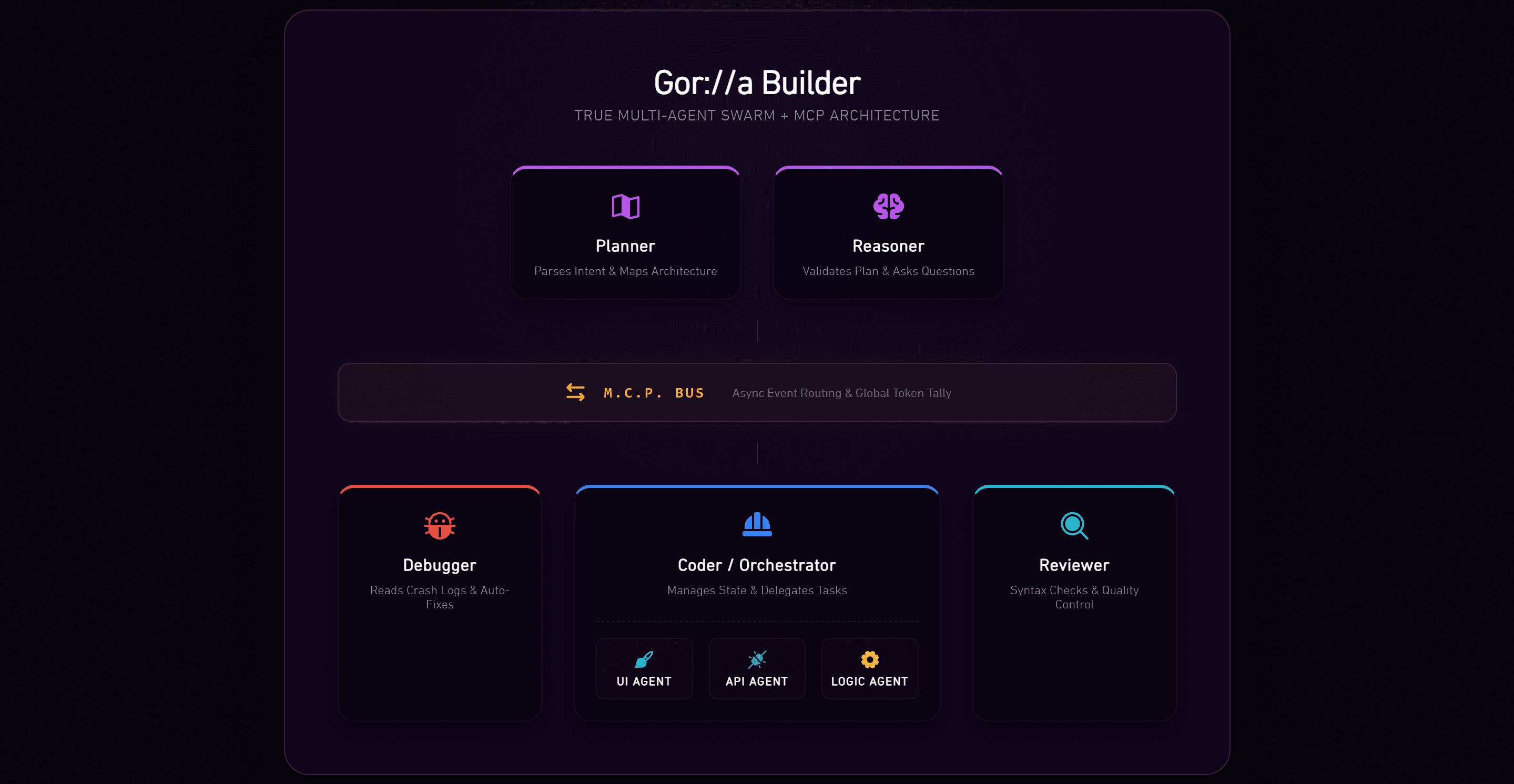
Under the hood, the entire platform now runs on a custom MCPBus—the nervous system of the swarm. Instead of monolithic generation, we broke the AI down into specialized, communicating personas:
The Planner parses your request and maps the architecture.
The Reasoner intercepts the plan, aggressively looking for missing dependencies (e.g., "Wait, this plan has frontend UI but no API routes to fetch the data").
The Coder acts as the general contractor, delegating files to sub-agents (UI, API, and Logic Specialists).
The Reviewer audits the final code for syntax and logic errors.
Enter X-Mode: Gemini 3.1 Pro & Architectural Agents
While the standard swarm handles everyday builds flawlessly, our premium users need a system that can handle massive, complex software infrastructure.
For them, we are introducing X-Mode. If the standard swarm is a dev agency, X-Mode is a principal engineering division. Powered exclusively by Gemini 3.1 Pro (the highest-end reasoning model available), X-Mode features an extended, high-latency MCP bus capable of immensely deep logical routing. It injects dedicated Architectural Agents into the pipeline—specialists that map out complex database schemas, secure state management, and overarching system design before the standard Coder agent is even allowed to touch a file.
Bidirectional Intelligence (The AI Pushes Back)
If your prompt is vague, the swarm will no longer guess. If the Reasoner determines the Planner's blueprint has too many blind spots, it triggers a QUESTION intent. The swarm hits the brakes, reaches out to the frontend, and asks you for clarification before it writes a single line of code.
The Engineering Crucible: Taming the Swarm
Building a multi-agent system is like trying to herd hyperactive cats. Giving different LLMs the ability to converse, critique, and write files in a shared environment nearly destroyed our infrastructure. We had to disarm three major traps to stabilize the system:
1. The Infinite "Clone War" Loop
When we first wired up the Coder and the Reviewer, they got trapped in endless loops of aggressive politeness. The Coder would generate a file, the Reviewer would flag a missing React import, the Coder would fix it but accidentally wipe a Tailwind class, and the cycle repeated ad infinitum. The Fix: We implemented a strict Orchestrator with a "Stability Counter." It watches the asynchronous operation queue. If file modifications remain perfectly stable for a few seconds, the Orchestrator steps in, forcefully declares the job done, and commits the code.
2. The Token Hemorrhage
Having 8 different agents "thinking" simultaneously is a fantastic way to burn through millions of tokens in minutes. Passing full codebase contexts to a Reviewer agent just to check if a function was exported properly was bankrupting the system. The Fix: Heuristic Short-Circuiting. We built high-speed, zero-token Python layers. Before the Reviewer ever pings the LLM, it runs hardcoded syntax validations to catch missing imports or broken Express routes for free.
3. The Race Condition Massacre
Because the UI and API Sub-Agents operate asynchronously, they were concurrently trying to inject code into server.js at the exact same millisecond, corrupting the AST and crashing the WebContainer. The Fix: The Aggregation Queue. Agents no longer write to the file tree directly. They submit payloads to the bus. When a run finalizes, the Orchestrator collects every operation, flattens them, and aggressively deduplicates by file path—ensuring only the absolute final, integrated version reaches your browser.
The Result
With the new swarm architecture and X-Mode active, Gor://a Builder has evolved from a simple code-generator into a senior engineering team. It plans before it acts, it fixes its own syntax errors before you even see them, and it finally asks you the right questions when you give it the wrong instructions.